


Life Along the Riverbank
Most of my time with jaguars was spent on the water, scanning the banks for a flick of an ear or a pattern of rosettes that didn’t belong to the shadows. When an encounter came, it rarely felt staged or rushed. These cats move on their own schedule, and the boats simply follow at a respectful distance.
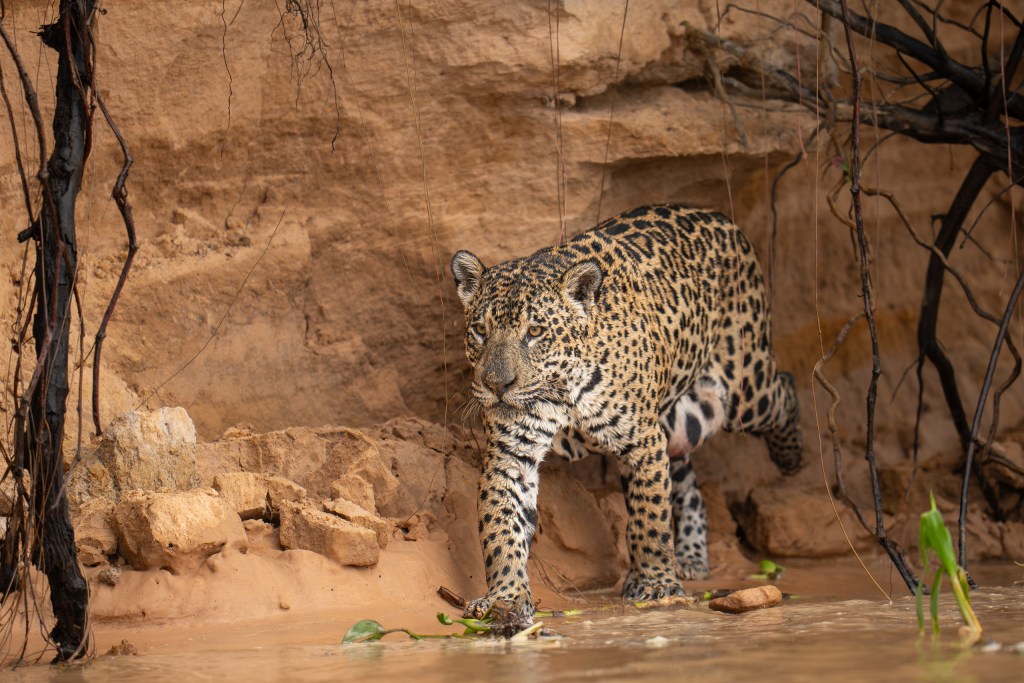
This jaguar emerged from beneath an eroded bank, stepping into the shallows with its eyes fixed forward. The warm tones of the exposed earth and the tangle of roots hanging overhead show how much of the jaguar’s world here is defined by the edge where land meets river.
Other moments were quieter. Jaguars spend a great deal of the day resting, often stretched along a bank just above the waterline.
This one held my gaze for a long time, unbothered, half-screened by vines and dry branches.

A Moment to Pause — A jaguar pauses among the dense vegetation along a riverbank in Brazil’s Pantanal.
A Cat That Belongs to the Water
Unlike most big cats, jaguars are comfortable in water and are strong swimmers. In the Pantanal, that ability shapes how they hunt and how they move through their territory.
I photographed this jaguar crossing the river in the last warm light of the day. Only its head and shoulders showed above the surface, with reeds and riverbank vegetation glowing behind it.

Moments later — or on another evening, in fading light — a jaguar launched itself out of the river and up into the dense bank vegetation.
It is a reminder that what looks like a calm riverside scene can change in a second.

The Rest of the River…
I came for jaguars, but the Pantanal is far more than one species.
The same rivers support a remarkable range of birds, mammals, and reptiles, and many of my favorite frames from the trip came between jaguar sightings.
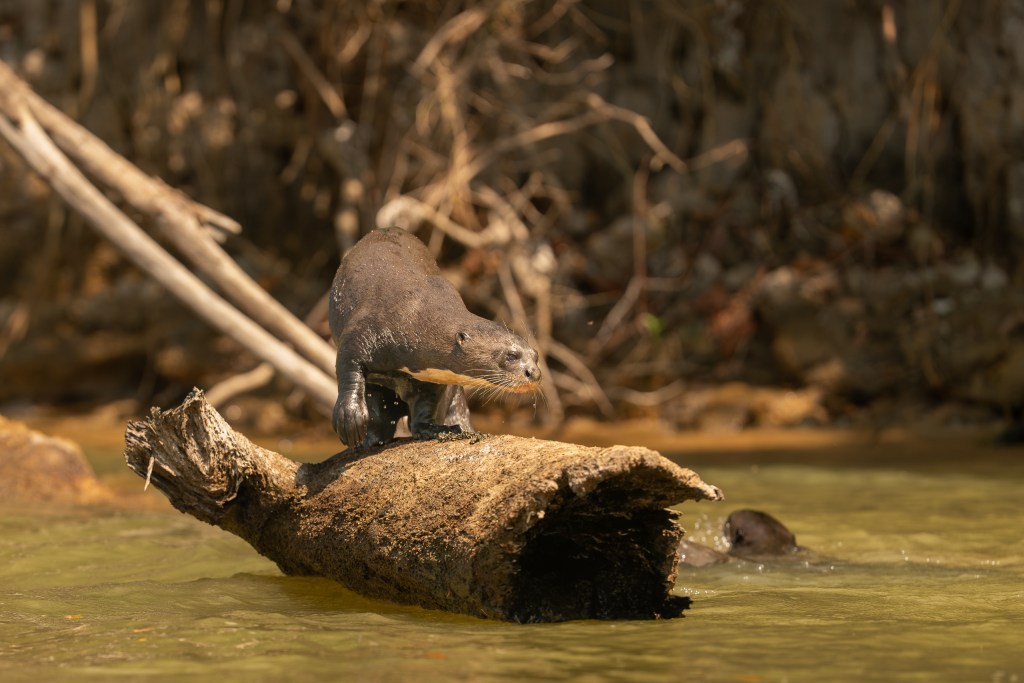
Giant otters are among the Pantanal’s most charismatic residents. They live and hunt in family groups, and are classified as endangered.
Here, one pauses on a log while another surfaces just beside it.
The ringed kingfisher is the largest kingfisher in the Americas. This one sat on a weathered branch above the water, feathers still slightly ruffled, its slate-blue and rufous plumage set against soft, warm background tones.

Ringed Kingfisher — A ringed kingfisher pauses on a branch along the waterways of Brazil’s Pantanal.
A yacare caiman rests at the water’s edge with its jaws wide open: a behavior known as gaping that helps it release heat in the Pantanal sun.
Shooting from a low angle brought me level with its eye and showed the rows of teeth, ridged scales, and armored back that have changed little over millions of years.

The Toco toucan is the largest of the toucans, and its oversized orange bill is unmistakable even at a distance.
Catching one in flight against a soft, open background was one of the more satisfying frames of the trip.

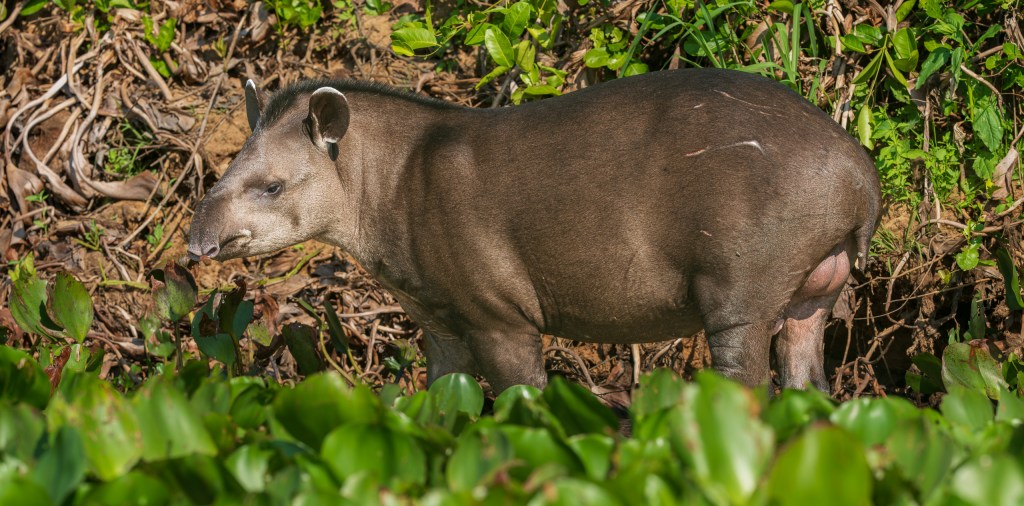
Weighing up to around 300 kilograms (660 pounds), the South American tapir is the largest native land mammal on the continent.
Though it’s often secretive and easy to miss. This one stood at the river’s edge among water hyacinth and leaf litter.
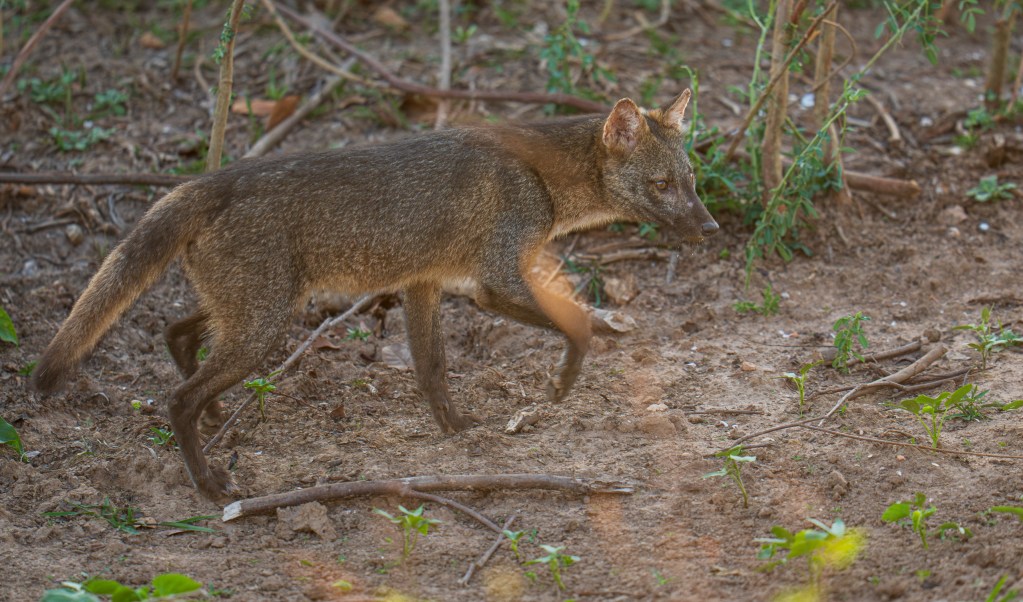
Despite its name, the crab-eating fox eats almost anything it can find: crabs on the flooded plains, but also fruit, insects, and small animals. It’s common across the Pantanal yet easy to miss, slipping through the brush most often around dawn and dusk.
A green iguana crosses a sunlit clearing with its crest of spines raised along its back.
Green iguanas spend much of their lives in trees near water, where they feed on leaves, flowers, and fruit, and they are strong swimmers. If threatened, they often drop from overhanging branches straight into the river below. On the ground they move with a deliberate, prehistoric gait, and the large, round scale below the ear, called the subtympanic shield, stands out clearly in this frame.

Not every large animal in the Pantanal is native.
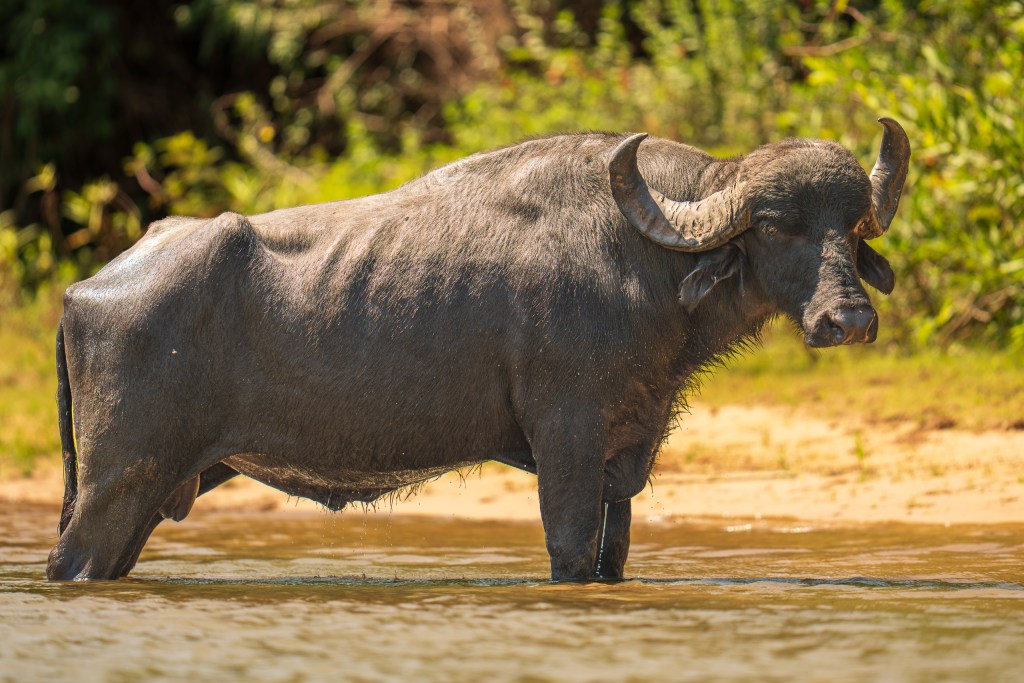
Water buffalo, originally from Asia, were brought to parts of the region for ranching, and some herds now live wild along the rivers and wetlands. They are well suited to this landscape: water buffalo have relatively few sweat glands, so they spend long hours in rivers and mud wallows to stay cool. This one stood in the shallows, water still dripping from its coat, its heavy swept-back horns catching the midday light.
Returning to the River
The Pantanal doesn’t reveal everything at once. It asks for patience: hours on the water, long stretches of quiet riverbank, and a willingness to wait without knowing what comes next.
That patience matters most with jaguars.
In much of the Americas they are so elusive that even people who share their forests may go a lifetime without seeing one.
Here, along these rivers, the odds shift. Few places on Earth let you spend time with a wild jaguar in daylight, and the Pantanal is one of them. They are the reason many of us travel here, and every encounter feels earned.
What stays with me is the whole system: the rivers, the wildlife they support, and the decades-long shift that made it possible to witness all of this so closely.